PHYSICAL AI IS NOW BECOMING MARKET-READY
How is a Physical AI System Structured?
The reason Physical AI is making the leap into practical application right now is due to three simultaneous developments. First, foundation models for robotics have emerged. Instead of being programmed individually for every task, robots are now learning general skills like grasping or navigating. Second, robots can practice millions of times in simulations using synthetic data before they ever set foot on a real factory floor. Third, sensors, actuators, and onboard computing power have become significantly more affordable and powerful. The majority of industrial value creation does not happen on a screen, but in production, warehousing, and intralogistics. Until now, AI has been of little help in these areas because it lacked an understanding of physical processes.
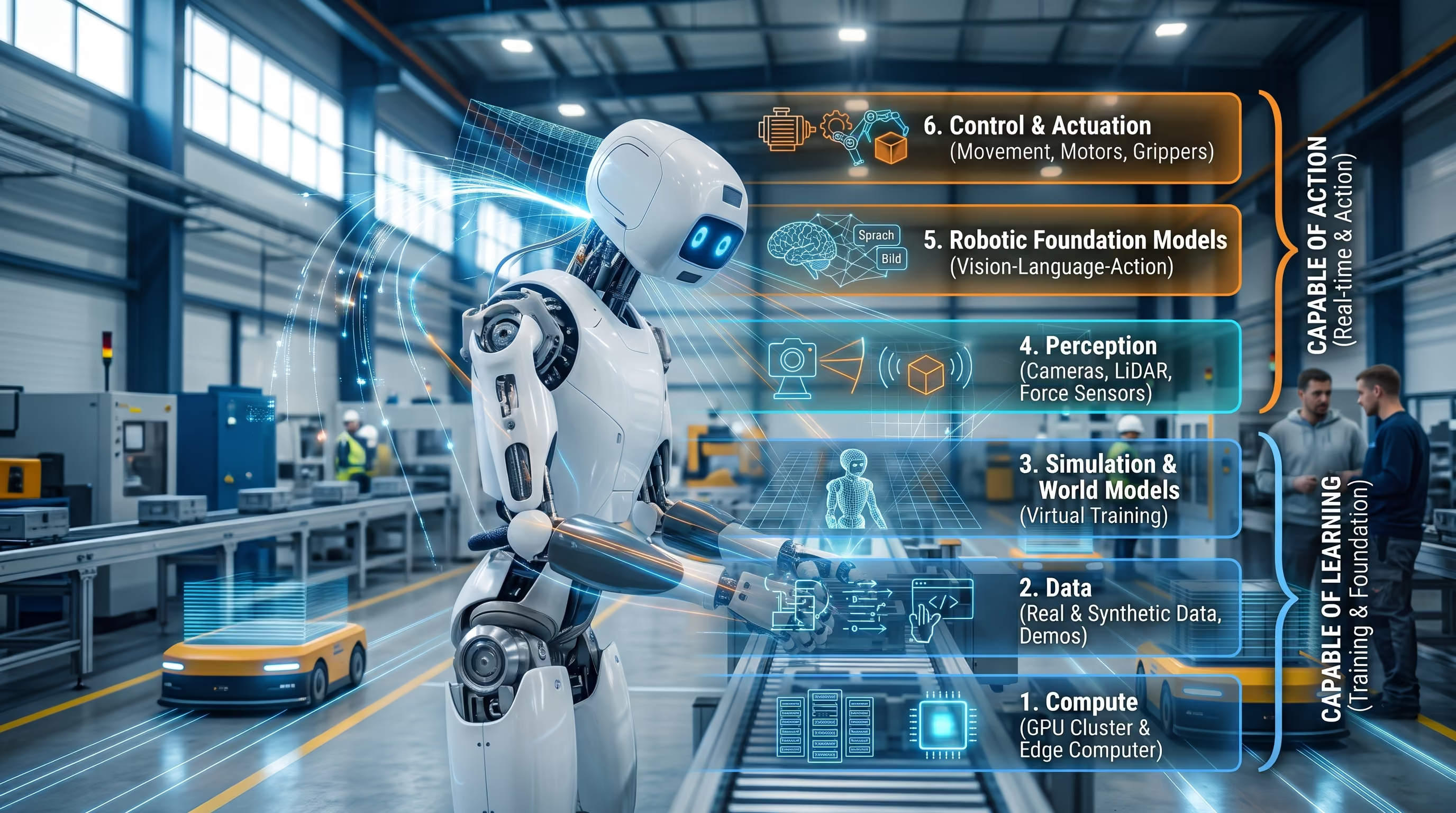
A Physical AI system consists of several technical layers, collectively known as the Physical AI stack. The bottom three layers enable the system to learn, while the top three enable it to act. The foundation is computing power: GPU clusters in data centers train the models, while a compact edge computer inside the robot executes them in real time. Built upon this is the data from which a robot learns, ranging from teleoperation and human demonstrations to real process data and synthetic data. The third layer consists of simulations and world models, where robots practice virtually before being deployed in the real world. The top three layers operate within the robot itself. Perception captures the environment and the robot's own body via cameras, depth sensors, LiDAR, and force and tactile sensors. Robotics foundation models, such as vision-language-action models, translate camera images and instructions into movement. Finally, control and actuation physically execute these decisions through motion planning, motors, joints, and grippers.