Physical AI: The next Evolutionary Stage of Artificial Intelligence
Physical AI is considered the next evolutionary stage of artificial intelligence because it doesn't just generate digital content—it acts in the real world through robots and machines. We explain what lies behind the term, why the breakthrough is happening right now, and how companies in production and logistics are already laying the foundation for it today using objective process data.
11/10/2026
6
Minutes reading time
Over the past few years, one topic has dominated the technology debate: generative AI. Tools like ChatGPT, image generators, and copilots demonstrate how powerful AI has become in handling language, code, and data. Yet, as proficient as these systems are at creating digital content, they stop at one boundary: they do not directly interact with the physical world.
This is precisely where the next stage of development begins: Physical AI. Our thesis for the coming years is that the true AI revolution begins where AI no longer just answers, but acts.
In this article, we explain what Physical AI is, why it is making the leap into practice right now, and what companies in production and logistics can do today to be prepared.
What is Physical AI? A Definition
Physical AI refers to AI systems that perceive the real world through sensors, learn physical relationships from data, and act autonomously on that basis. This includes properties such as friction, weight, and inertia, as well as the cause and effect of a movement.
Instead of just processing text or images, Physical AI learns from real-time sensor data: how an object behaves when grasped, how much force a grip requires without damaging the material, or how people move in a room. It derives predictions and actions from this.
The decisive difference from previous AI generations: Physical AI does not remain in the digital realm. It acts as the "brain" in physical systems, such as industrial robots, autonomous mobile robots, humanoid robots, or vehicles, and directly alters its environment.
The term Embodied AI is closely related. It originates from research and emphasizes that intelligence emerges through a body and its interaction with the environment. Physical AI is the broader, more application-oriented term that has primarily gained traction in the industry.
The Stages of AI Development: From Perception to Action
A look at the development of the last decade or so shows why Physical AI is becoming market-ready right now. The foundation for everything was accelerated computing: specialized hardware like GPUs, without whose processing power modern AI models could neither be trained nor operated. Four stages are built upon this, as described by NVIDIA and others:
Perception AI: AI learns to recognize images, language, and patterns. Typical examples are image recognition and speech recognition.
Generative AI: AI understands contexts and uses them to create new digital content such as text, images, or code. This stage continues to shape the public perception of AI today.
Agentic AI: AI agents independently plan multi-step tasks and use digital tools, for example, to conduct research or control processes in software.
Physical AI: AI transfers perception, understanding, and planning into the real world and acts there via robots and machines.
At CES 2026, NVIDIA CEO Jensen Huang declared that the turning point for Physical AI had been reached: machines were beginning to understand the real world and act within it. Forbes subsequently classified this as a deliberate phase shift in which Physical AI is moving from research into industrial application.
Why the Real AI Revolution is only just Beginning
Generative AI is transforming digital knowledge work. However, a large portion of value creation does not take place at a screen, but on the shop floor: in production, in the warehouse, in intralogistics, and in healthcare. Until now, AI could barely help here because it lacked an understanding of physical processes. Three developments are currently changing this simultaneously:
Foundation models for robotics: AI models learn general skills like grasping or navigating instead of being programmed individually for every task.
Simulation and synthetic data: Robots can practice millions of times in virtual environments before they work in the real facility.
More affordable hardware: Sensors, actuators, and on-device processing power have become significantly cheaper and more powerful.
Only when AI can perceive, decide, and physically intervene does it unleash its impact where companies organize the majority of their processes. Read more about the technical building blocks in our article, The Physical AI Stack.
Why Physical AI needs Process Data first
Physical AI is only as good as its understanding of the work it is intended to take over. A robot picking goods or delivering material to the line must know how these tasks are actually performed today: what paths are taken, how often items are gripped, lifted, or waited for, and where humans are under particular physical strain. This is precisely the data missing in most companies. ERP and warehouse management systems show what has been completed, but not what manual work looks like in detail. Process recording via stopwatch or observation only provides random samples and is hardly comparable.
This leads to three specific questions that should be answered before any Physical AI project:
Where is automation worthwhile? Only objective data on time shares, paths, and repetitions show which activities have the greatest potential.
Where does it relieve people the most? Ergonomics data makes it visible where heavy lifting, awkward postures, or high repetition rates occur.
Was it worth it? Without a baseline measurement, the effect of a robot cannot be proven after its introduction.
This is exactly where our focus lies: with data-driven process and motion analysis, we make it visible how people and processes actually move in the physical world.
Physical AI by in Numbers: A Market evolving
All major market research institutes expect strong growth for humanoid robots and embodied AI, but they disagree on the pace. The following forecasts refer to these sub-markets, not to Physical AI as a whole:
The range itself is a statement: There is a factor of about four between the most cautious and the most optimistic forecast. This shows how early we are in this development. The direction is certain; the pace and the order in which individual industries benefit remain open.
What Companies can Do Right Now
Those who lay the foundations today can deploy Physical AI in a targeted manner later, rather than chasing after pilot projects. Initial real-world applications are emerging primarily in manufacturing and intralogistics, such as in order picking, transporting containers, or providing material at the line. For decision-makers, this results in four steps:
Make processes measurable: Capture how manual tasks are performed today using objective data instead of estimates.
Identify candidates: Look for activities with high repetition rates, long paths, or high physical strain. That is where the benefit of automation is greatest.
Clearly define pilots: Start with a manageable area and define in advance how you will measure success.
Prove results: Compare with the baseline measurement after implementation. This is the only way to turn a pilot project into a sound investment decision.
This allows for a realistic assessment of where Physical AI relieves your own value creation and where it does not (yet).
Conclusion
Physical AI is shifting the focus of AI from generating digital content to perceiving, deciding, and acting in the real world. How quickly this will impact individual industries remains to be seen, as evidenced by the widely varying market forecasts. One thing is clear, however: the companies with the greatest advantage are those that already have a precise understanding of their physical processes today.
Would you like to know where Physical AI can be applied to your processes?
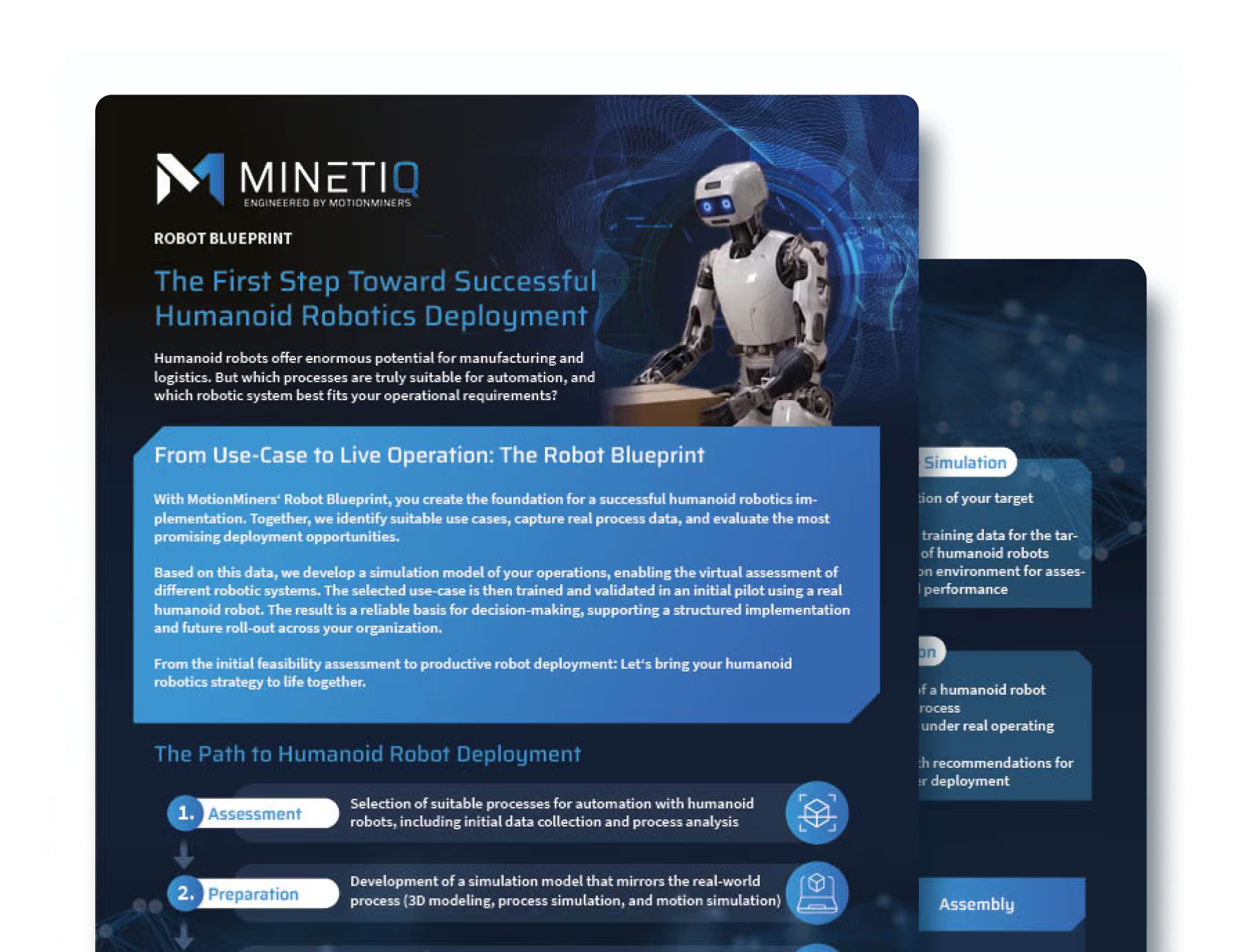
Our free factsheet shows you how to implement humanoid robotics in production and logistics with confidence: from process analysis to full-scale deployment.
From use case to live operation
An overview of results from every project phase
Concrete use cases for intralogistics, production, and assembly